Groundwater and Recharge Validation
The Phase 1 groundwater section tests both local groundwater bookkeeping and lateral groundwater dynamics. The central implementation change is the asynchronous scheduler: vadose drainage, recharge production, and capillary rise are evaluated every surface-model step, while saturated groundwater storage and lateral heads are updated only when the groundwater scheduler is due.
What was tested
Four V-tilted groundwater cases were used for local storage and scheduler behavior:
P1-GW-ASYNC-001: constant recharge water-table rise;P1-GW-ASYNC-002: asynchronous scheduler equivalence;P1-GW-CAP-001: capillary rise drawdown;P1-GW-MOUND-001: Boussinesq recharge mound against a fine-timestep numerical reference.
Two additional hillslope cases were used to strengthen the lateral-groundwater evidence:
P1-GW-HILL-STEADY-001: steady Dupuit profile;P1-GW-HILL-TRANSIENT-001: transient linearized Boussinesq decay.
Local recharge and scheduler behavior
Reference and method
The local recharge case uses the analytical storage relation Δh = RΔt / S_y when lateral groundwater flow and exfiltration are disabled. The scheduler-equivalence case compares legacy per-step groundwater updating with the asynchronous accumulation scheduler. The capillary-rise case applies a simple physically capped upward flux from shallow groundwater to dry vadose storage. The recharge-mound case activates lateral groundwater flow and compares the asynchronous result with a fine-timestep internal numerical reference.
Main result
All four local groundwater cases passed.
| Case | Regime | Head RMSE (m) | Max head error (m) | Storage error (%) | Residual (m³) |
|---|---|---|---|---|---|
P1-GW-ASYNC-001 | Local recharge | 0.0 | 0.0 | 0.0 | 1.96 × 10^-11 |
P1-GW-ASYNC-002 | Scheduler equivalence | 1.71 × 10^-13 | 1.71 × 10^-13 | 1.67 × 10^-11 | 1.84 × 10^-10 |
P1-GW-CAP-001 | Capillary rise | 0.0 | 0.0 | 0.0 | -1.45 × 10^-12 |
P1-GW-MOUND-001 | Boussinesq mound | 1.83 × 10^-8 | 9.90 × 10^-8 | 5.23 × 10^-13 | 3.09 × 10^-11 |
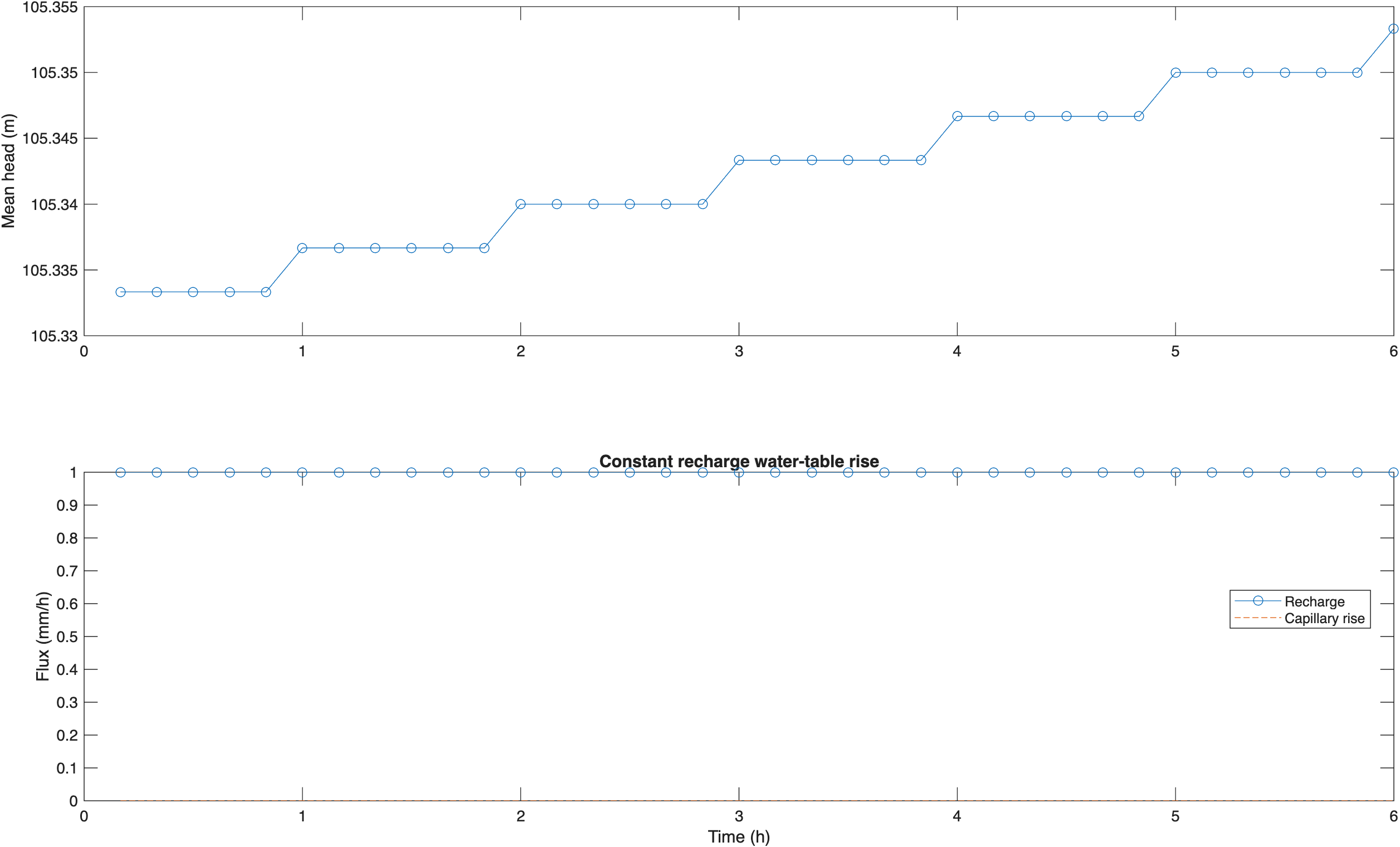
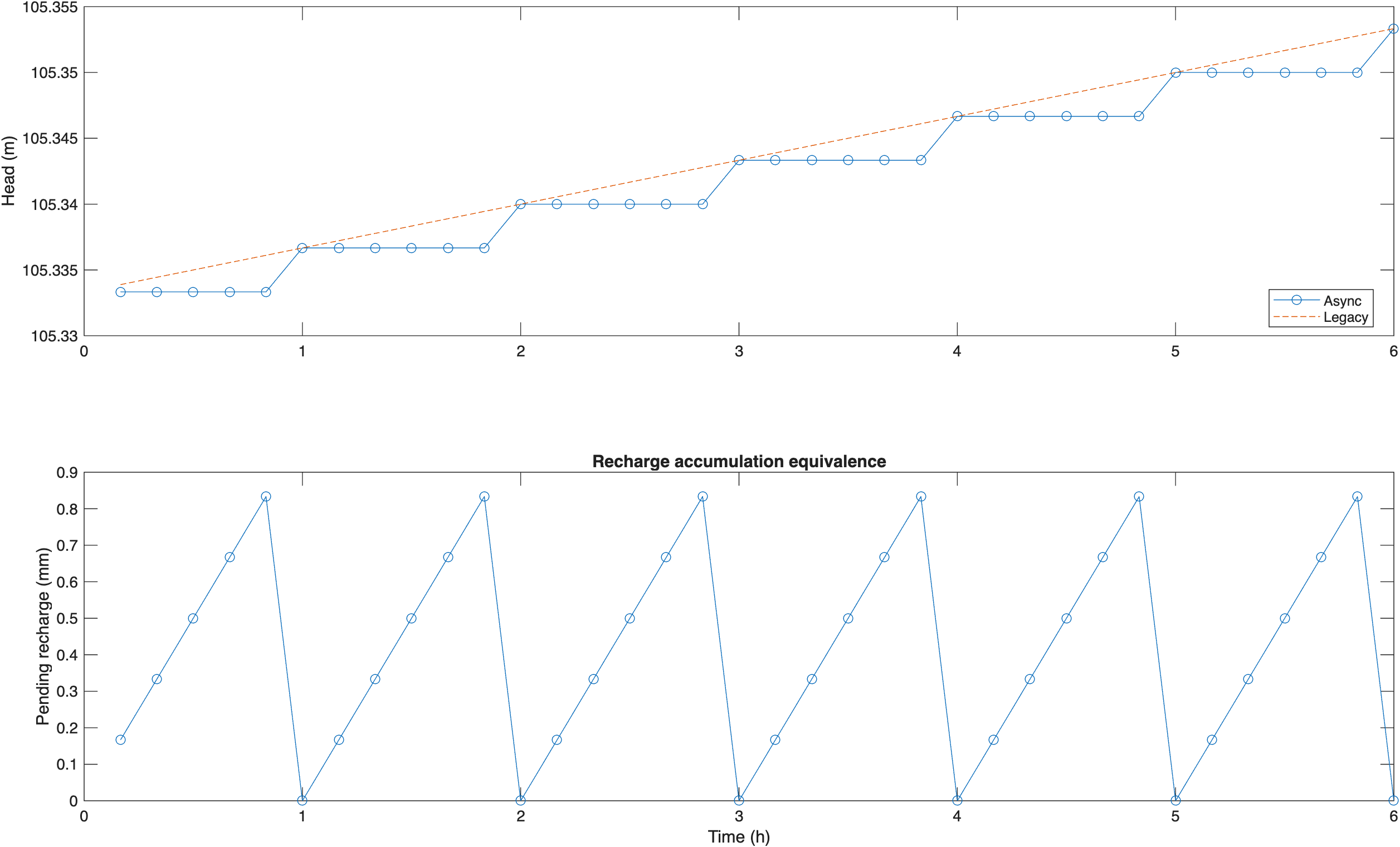
Recharge scheduler diagnostics. The first case checks analytical water-table rise under constant recharge. The second compares the asynchronous scheduler with legacy per-step groundwater updating.
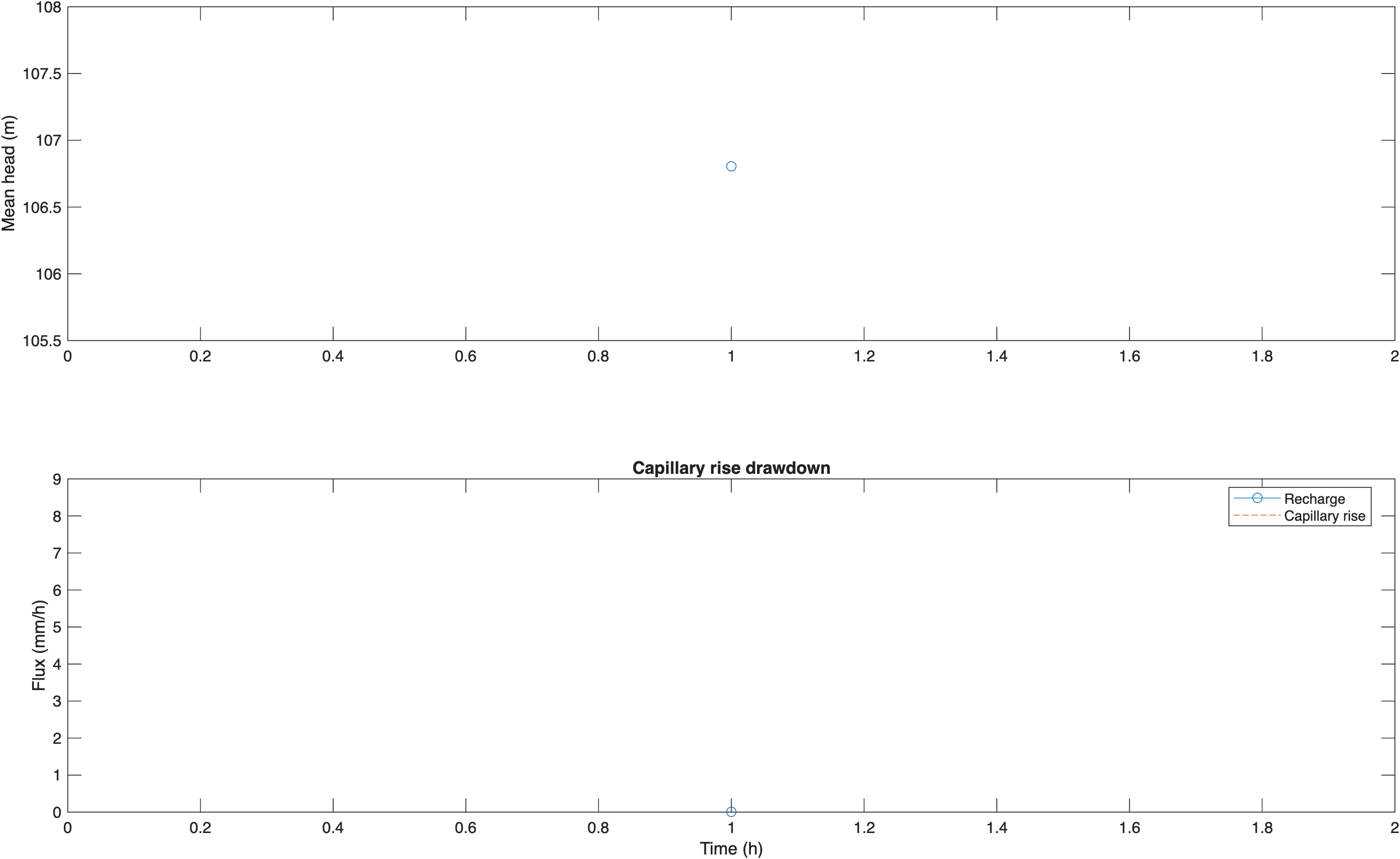
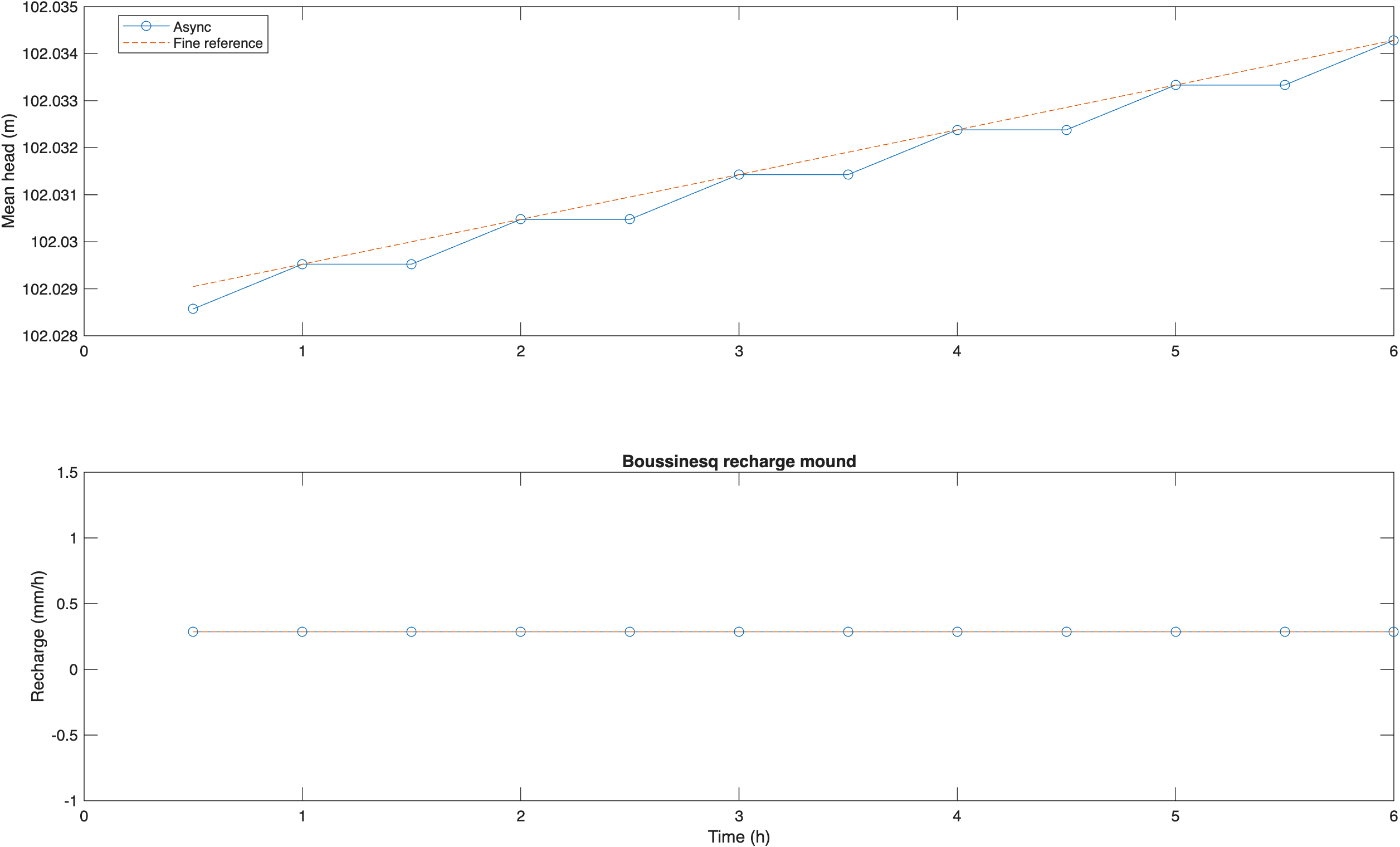
Capillary-rise and lateral-flow diagnostics. The mound case is useful numerical-reference evidence, but it is still weaker than an analytical benchmark.
The main result is that recharge accumulation, asynchronous groundwater updating, and the simple capillary-rise closure all behaved as intended under controlled conditions.
Analytical hillslope benchmarks
Reference and method
The steady hillslope case compares HydroPol2D with the closed-form Dupuit profile under uniform recharge and a fixed drain head. The transient hillslope case compares the HydroPol2D Boussinesq solver with the first eigenmode of the linearized Boussinesq equation in the small-perturbation regime.
Main result
Both analytical hillslope cases passed.
| Case | Benchmark | Head RMSE (m) | Max head error (m) | Flow metric |
|---|---|---|---|---|
P1-GW-HILL-STEADY-001 | Steady Dupuit | 6.04 × 10^-3 | 9.75 × 10^-3 | Drain-discharge error = 3.74 × 10^-4 % |
P1-GW-HILL-TRANSIENT-001 | Linearized Boussinesq | 1.94 × 10^-5 | 4.46 × 10^-5 | NSE = 0.99985 |
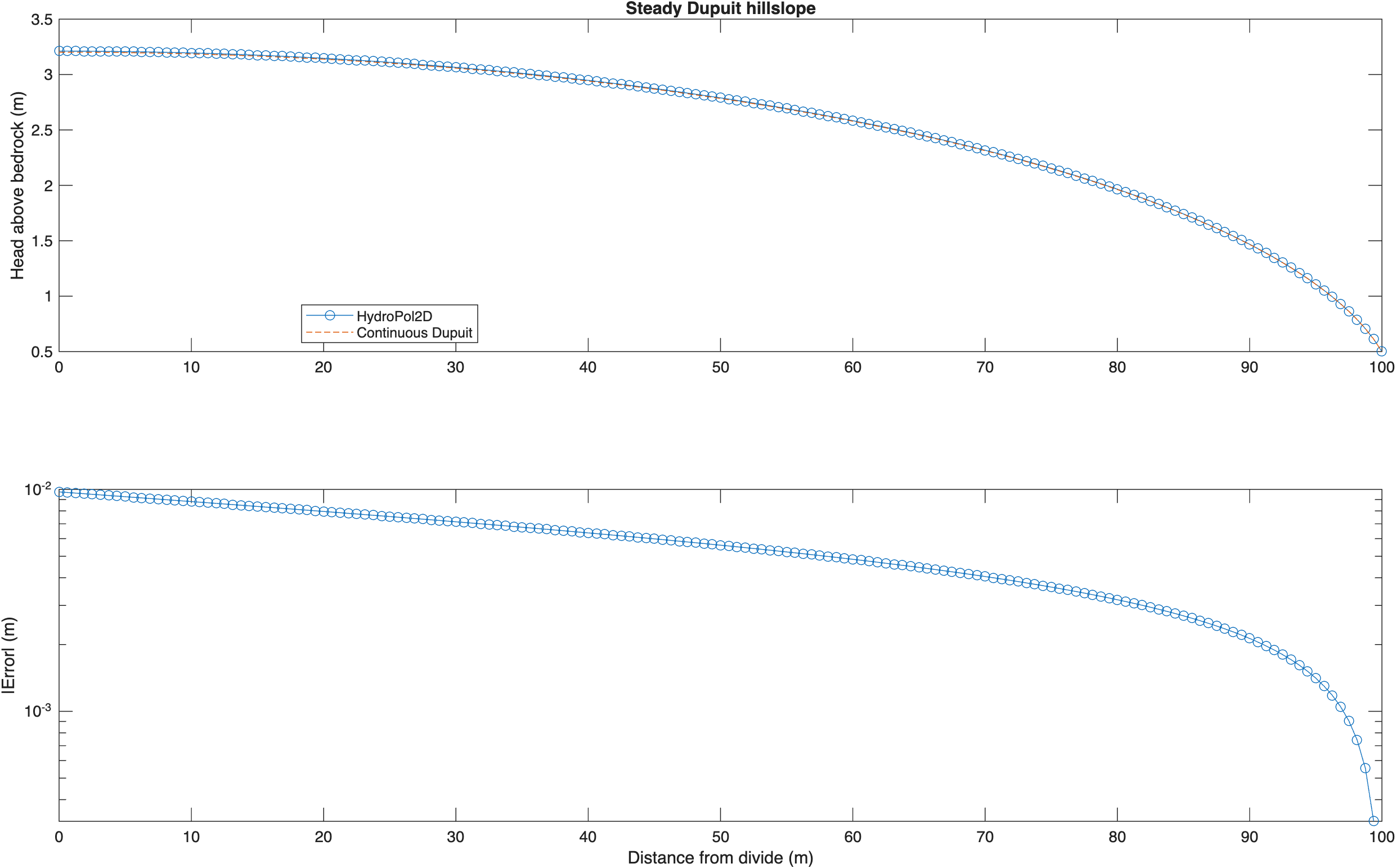
Steady Dupuit benchmark. The lower panel shows the absolute profile error against the analytical solution.
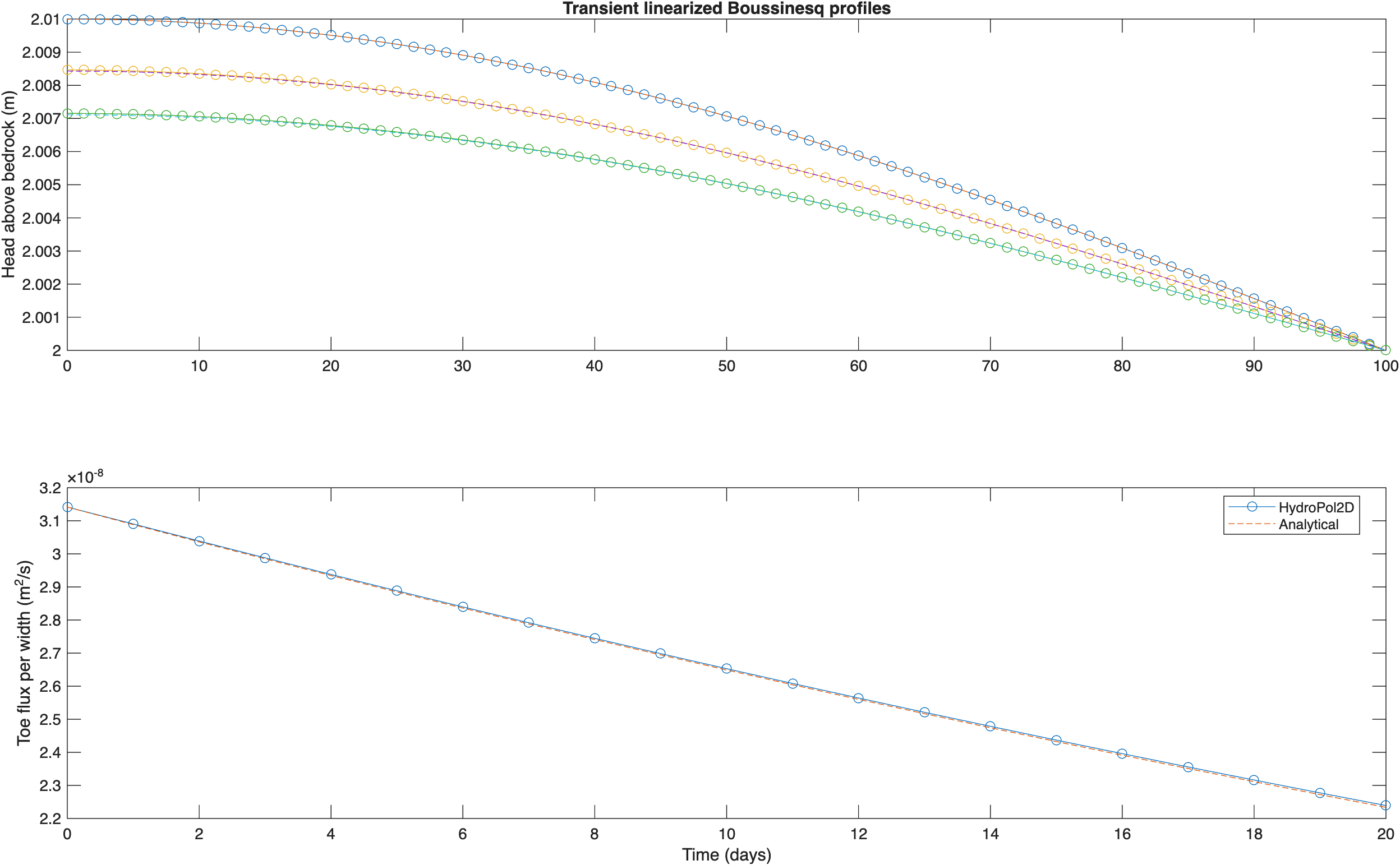
Transient hillslope benchmark. The upper panel compares head profiles during perturbation decay; the lower panel compares modeled and analytical toe flux per unit width.
What this validation supports
Together, these cases support the implemented recharge accumulation, asynchronous scheduler, local water-table rise and drawdown through S_y, simple layered capillary rise, and idealized lateral hillslope groundwater dynamics.
They do not validate regional aquifer parameters, field baseflow, groundwater pumping, confined aquifer behavior, or calibration against observed wells.