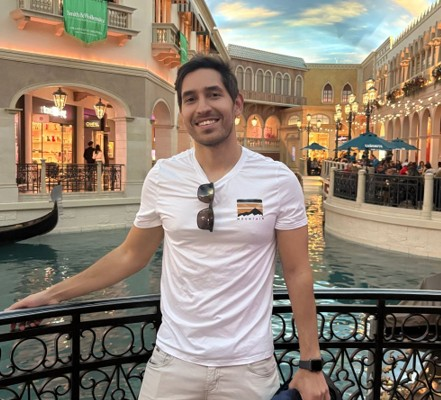
About Me
Welcome to my GitHub page.
Hi, I am Marcus, a researcher originally from Brazil who enjoys barbecuing, watching soccer games, trying new recipes in my free time, and is passionate about understanding how water behaves.
News
2026
“Assessment of urban vulnerability to floods under current and future demographic and climate scenarios” was published in International Journal of Disaster Risk Reduction. View the article.
“Risk management framework for urban catchments under non-stationary analysis: Mitigation and adaptation scenarios in a Brazilian case study” was published in Urban Water Journal.
“Modeling and Design Optimization of Looped Water Distribution Networks using MS Excel: Developing the Open-Source X-WHAT Model” was accepted for publication in Water Resources Management. Read the preprint.

“Identifying the State Dependence of Effective Material Properties in a Simplified Hydrologic Hillslope Model” was published in Water Resources Research.

“Field Scale Test Bed for Assessment of the Surface Runoff and Water Quality Performance of Permeable Pavements” was published in Journal of Hydrologic Engineering.
“LID-Design Atlas: Mapping Hydrologic Performance and Cost Trade-Offs in Infiltration-Based LID Design” was published in Journal of Hydrologic Engineering, 31(5), 04026043. View the article.

“Flood Event Escalation and Urban Drainage Design Implications Under Nonstationary Rainfall in Sao Paulo State, Brazil” was published in Water.

I gave a research talk at Stanford University titled “Designing Open-Source Tools for Simulating Hydrological Processes: Challenges and Lessons from Building from Scratch.” The talk covered my research in flood and water-quality modeling, dam-break simulation, and my Ph.D. work at the University of Sao Paulo.
I was born in 1995 and spent my early years up to college in my hometown in the state of Paraná, Brazil. Growing up in such a small city allowed me to explore my curiosity for nature to a wonderful level. I always remind myself, as a kid playing in the storm (still do to this day sometimes), building small earth dams - perhaps that was my first memory related to civil/environmental or water resources engineering.
Life was simple; we had no cellphones, no internet, and it was just our free time and curiosity to play with my friends, fail, learn, grow, have fun, and that inspired me so much to develop the intimate desire to not only see work as a responsibility, but also to find joy in doing it.
I honestly think this is essential if one wants to do great work.
My father worked in the water resources council of our state, and my mother was a teacher. Both inspired me to follow a path in academia and to work with water resources.
Bruce Lee once said:
“If you put water into a cup, it becomes the cup. You put water into a bottle, and it becomes the bottle. You put it in a teapot, it becomes the teapot. Now, water can flow or it can crash. Be water, my friend”.
This has always been on my mind. The movement of water shapes the way life works, in some way.
Studying how water can change its shape, force, velocity, and physical properties, and how it can rapidly or sometimes take years to move under a specific medium, is just one of the few amazing phenomena I am interested in understanding and learning from. This is beautiful.
I would describe myself as a simple, passionate researcher in the field of water resources, continually striving to learn something new every day about this fascinating area.
My formal education includes a background in Civil and Environmental Engineering, Hydrology and Atmospheric Sciences, and Hydraulic Engineering and Sanitation.
I was a postdoctoral researcher at the University of Arizona - Hydrology and Atmospheric Sciences studying hillslope hydrology merged with data assimilation techniques applied to one of the world’s most extensive field experiments in hillslope hydrology - The Landscape Evolution Observatory Hillslope.
Currently, I am a postdoctoral researcher in the Department of Earth System Science at the Stanford Doerr School of Sustainability. I reconstruct historical flood exposure in California and India and study how those exposure patterns may relate to health outcomes.
I hold a bachelor’s degree in Civil Engineering (2013-2018), a Master’s degree (2018-2020) and Ph.D. (2020-2023) in Hydraulics and Sanitation Engineering at the University of Sao Paulo. My PhD thesis was awarded the best in the field of Engineering by the University of Sao Paulo.
In addition, I also have another ongoing Ph.D., which I started in 2020, in Civil and Environmental Engineering from the University of Texas at San Antonio, from which I still have one last credit to graduate, with plans to graduate after my postdoctoral studies.
I also have a YouTube channel and a website where I share a variety of spreadsheets (over 80) and articles across multiple fields, including hydrology, hydraulics, structural engineering, geotechnics, and general comments. This website, which to this date has provided more than 100,000 spreadsheets downloaded by people in around 10 countries, has allowed me to develop an interesting connection between the academic world and practical solutions, sharpening my thinking for both levels. More information about this can be found in my CV.
Research
Dynamic water risk in a changing Earth system
Water hazards emerge from interactions among climate, rainfall, landscapes, infrastructure, and human exposure. My research asks how these connections change across places and over time. I combine physical models, satellite observations, field measurements, and open data to reconstruct past events, anticipate emerging risks, and evaluate possible responses. Floods are the main physical anchor of this work because they make these links visible. The larger goal is to understand how environmental change becomes unequal risk for people, infrastructure, and ecosystems.
How changing environments generate water extremes
I study how the spatial and temporal organization of rainfall, antecedent wetness, changes in land cover and land use, and aging infrastructure shape the nonlinear generation of runoff. I examine how these controls alter floods, droughts, and the hazards that follow.
How we observe and reconstruct floods
I couple remote sensing, topographic and bathymetric data, and scarce field observations with physics-based models to estimate flood characteristics such as extent and depth, especially where ground observations are limited.
How interacting hazards create global inequalities
I examine how floods interact with droughts, wildfires, hail, and cyclones, and how these hazards intersect with human exposure and the capacity to adapt. My goal is to map global gradients in vulnerability and show where natural hazards and socioeconomic conditions combine to produce unequal risk.
Current research
At Stanford, I am developing historical flood reconstructions for California and India and examining how flood exposure may relate to health outcomes. This work extends my research from the physics of hazards to their human consequences while carefully separating association from causation.
Please feel free to contact me at marcusnobrega.engcivil@gmail.com or through the academic and social links on this page.